The wording check
What the fair-housing and hiring checks look for, why each phrase is flagged, and what to write instead. It is a guide, not legal advice.
What the check does#
When you write an ad in one of the three housing categories or in Job opening, A9 Lister scans everything you typed into the form while you type. The result shows at the top of the preview.
- With nothing found, you see Fair-housing check: nothing to fix (or Hiring-language check: nothing to fix).
- With something found, you see Fair-housing check: 1 phrase to fix (or however many), then each phrase in quotes with a reason and a suggestion.
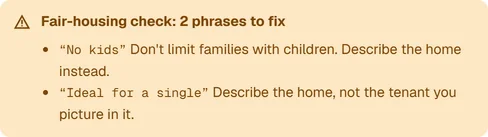
A flag is a nudge, not a block. You can still copy and post the ad. The decision is yours.

Fix a flagged phrase#
- Read the reason under the phrase.
- Find the phrase in the form. It is usually in Highlights, Move-in special or What's nearby.
- Rewrite it to describe the home or the job, not the person. For "ideal for a single professional", write what the place has: "quiet top-floor unit, 10 minutes to downtown".
- Watch the box at the top of the preview. When the phrase is gone, it turns green.
What the fair-housing check looks for#
The Fair Housing Act protects people from discrimination by race, color, religion, sex, national origin, familial status and disability. Many states and cities add more, such as source of income. The check looks for wording that suggests a preference or a limit on any of those. These are the patterns it knows:
| You wrote something like | Why it is flagged |
|---|---|
no kids, no children, no families | Don't limit families with children. Describe the home instead. |
adults only, adult community, adult building | Adult-only wording isn't allowed outside qualifying senior housing. |
ideal for a single, perfect for couples, great for students | Describe the home, not the tenant you picture in it. |
students only, professionals only, couples only | Limiting who can rent is risky. Describe the home instead. |
no Section 8, no vouchers, no housing assistance | Oregon and Washington protect renters who pay with vouchers or other assistance. |
young, mature, elderly | Words about age can read as a preference. Leave them out. |
able-bodied, no wheelchairs | Describe access (third floor, no elevator) instead of screening people out. |
English only, no foreigners, Americans only | National-origin preferences aren't allowed. |
Christian home, Muslim tenants, Jewish family | Religious preferences aren't allowed. |
Describing the place is always safe: bedrooms, floor, parking, pets policy, nearby transit. Describing who should live there is where ads get into trouble.
What the hiring check looks for#
On Job opening ads the check is called Hiring-language check.
| You wrote something like | Why it is flagged |
|---|---|
young, recent grad, digital native | Words about age can read as age discrimination. Describe the skills instead. |
salesman, waitress, foreman | Use neutral job titles like salesperson, server or technician. |
native English, citizens only | Ask for the language skill or work authorization you need, not national origin. |
no felons, clean criminal record | Oregon bars criminal-history questions before an interview. Leave this out of the ad. |
he will, she will | Write "you will" instead of he or she. |
What the check cannot do#
- It matches the phrases above and close variations. A different way of saying the same thing may not be caught.
- It reads only the form. It does not read your photos, your phone calls, your screening questions or the posting site's own fields.
- It does not know your local rules. Some places allow wording that others forbid, such as qualifying senior housing.
- "Nothing to fix" does not mean "approved". It means none of the known phrases were found.
The other categories (cars, furniture, services and anything else) have no wording check.